
How to Protect Countertops During Construction and Remodeling
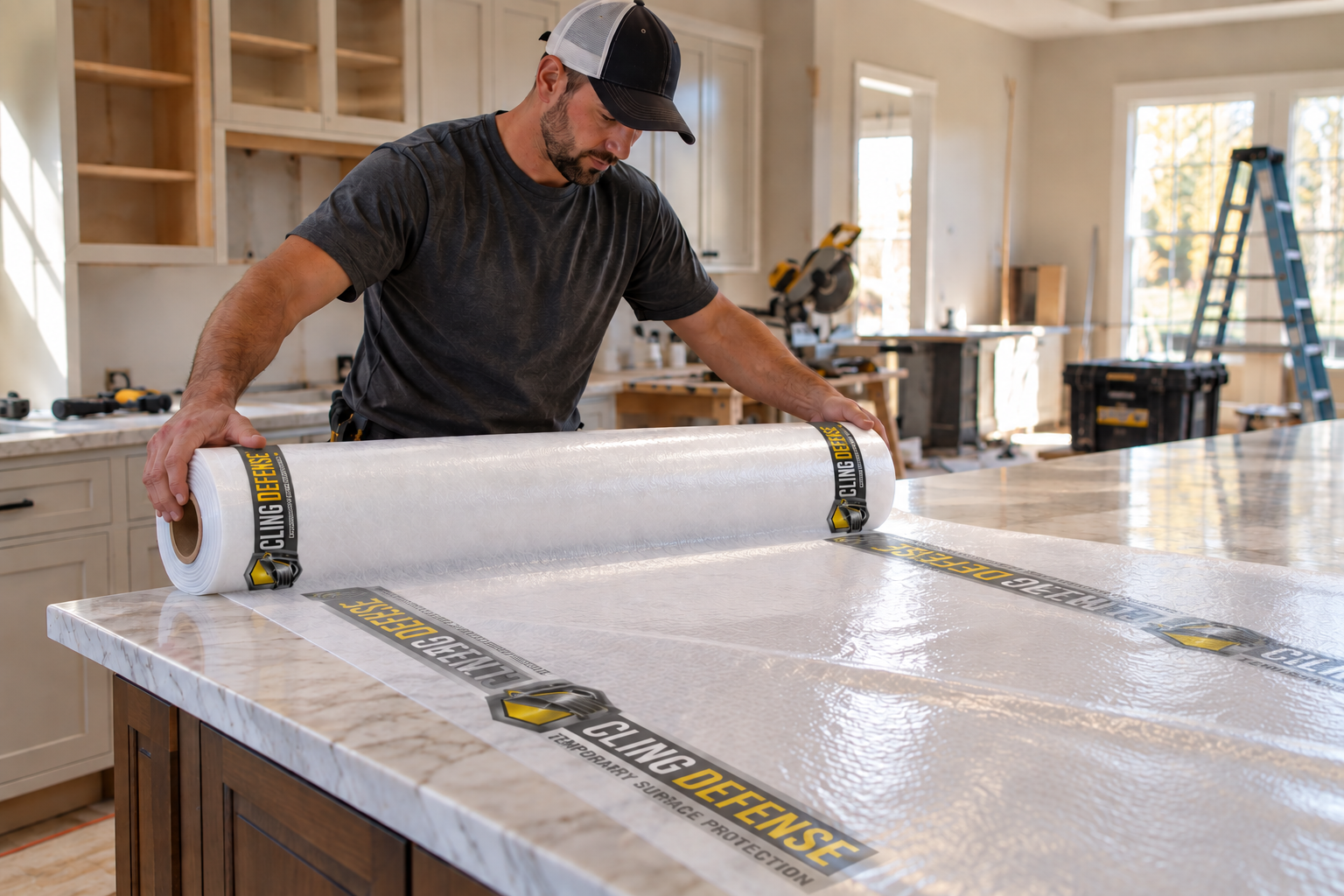
A roll of Cling Defense partially unrolled across a granite countertop, with a clean adhesive edge visible and light reflecting off the surface. The film covers and shields the counter from dust and scuffs while leaving a neat, temporary barrier for construction or renovation work.
The best way to protect finished countertops during construction or remodeling is to start with the condition of the surface, not simply the covering material. Confirm that the surface is suitable for protection, make sure it is clean and dry, remove loose dust and debris, and use temporary surface protection that can be properly fitted and removed when the work is complete.
That preparation matters on an active jobsite.
Consider a kitchen remodel where the countertops have already been installed, but the project is far from finished. Painters are touching up walls. Electricians are installing fixtures and outlets. Cabinet installers are making adjustments. Tools, boxes, hardware, dust, and other jobsite materials continue to move through the room.
The finished countertop can quickly become an unintended work surface.
Temporary countertop protection creates a barrier between that finished surface and normal construction activity. Cling Defense is designed as self-adhesive temporary protection for suitable finished surfaces, including countertops. It requires no separate tape, is highly breathable and leak resistant, and can often be removed, repositioned, and reused when conditions allow.
The key is using it correctly.
Why Finished Countertops Need Protection During Construction
A roll of gray protective film partially unspooled on a concrete floor, with a strip adhered smoothly to the surface showing a clean, matte finish and a textured backing visible on the roll.
A finished countertop may be installed well before the rest of a construction or remodeling project is complete. Once that happens, it becomes another finished surface that contractors have to work around while multiple trades continue moving through the space.
During a kitchen remodel, for example, painters may be working above or beside the countertop while electricians complete outlets, switches, or fixtures. Cabinet installers may return for adjustments. Other contractors may carry equipment, hardware, boxes, and tools through the room.
Even when everyone on the job is careful, active construction creates exposure to dust, debris, tools, paint, liquids, and other normal jobsite conditions.
The goal of countertop protection during construction is to establish a temporary barrier before that activity creates unnecessary exposure for the finished surface.
That protection should also fit into the broader surface-protection plan for the project. Cling Defense is designed to Protect More Than Just Floors, including countertops, stairs, glass, finished walls, doors, cabinets, millwork, and other suitable finished surfaces.
This makes it possible to think beyond floor protection when planning a remodel.
However, no temporary covering should be treated as a guarantee against every possible scratch, impact, chemical exposure, or form of jobsite damage. Contractors should still use appropriate work practices and avoid treating protected countertops as cutting stations, heavy-duty workbenches, or storage areas for materials that could damage the underlying finish.
What Should You Use to Protect Countertops During a Remodel?
The right temporary countertop protection should match the finished surface, jobsite conditions, expected project duration, and removal requirements.
For many contractors, another practical consideration is how the material will stay in place.
Traditional surface-protection methods may require separate tape or additional steps to secure the covering. That can add installation work, particularly when contractors need to protect several finished surfaces throughout the same room.
Cling Defense takes a different approach. It is an industrial-grade, self-adhesive temporary surface protection that uses cling properties to make contact with suitable finished surfaces. No separate tape is required.
It is also designed for more than horizontal floor coverage. The Cling Defense Protect More guidance specifically includes countertops, cabinets, stairs, glass, doors, millwork, finished walls, and other suitable finished surfaces.
Cling Defense is also highly breathable and leak resistant, helping prevent liquids from leaking through to protected surfaces. Leak resistant does not mean waterproof, and contractors should still address spills and jobsite liquids appropriately rather than relying on temporary protection as a waterproof barrier.
Surface suitability matters as well.
Specific countertop finishes should not automatically be assumed compatible based solely on the type of countertop. Requires confirmation from Cling Defense for specific finish compatibility. Follow the care requirements of the underlying surface and consider testing a small, inconspicuous area before a larger application.
For newly finished, coated, or treated surfaces, confirm the surface is fully cured and suitable for covering before applying protection.
How to Apply Temporary Countertop Protection
Proper application begins before the material touches the countertop.
Cling Defense's How It Works process follows three basic stages: Roll It Out, Smooth & Protect, and Remove & Reuse when conditions allow.
For countertop protection during construction, that process should begin with an inspection of the finished surface and careful preparation.
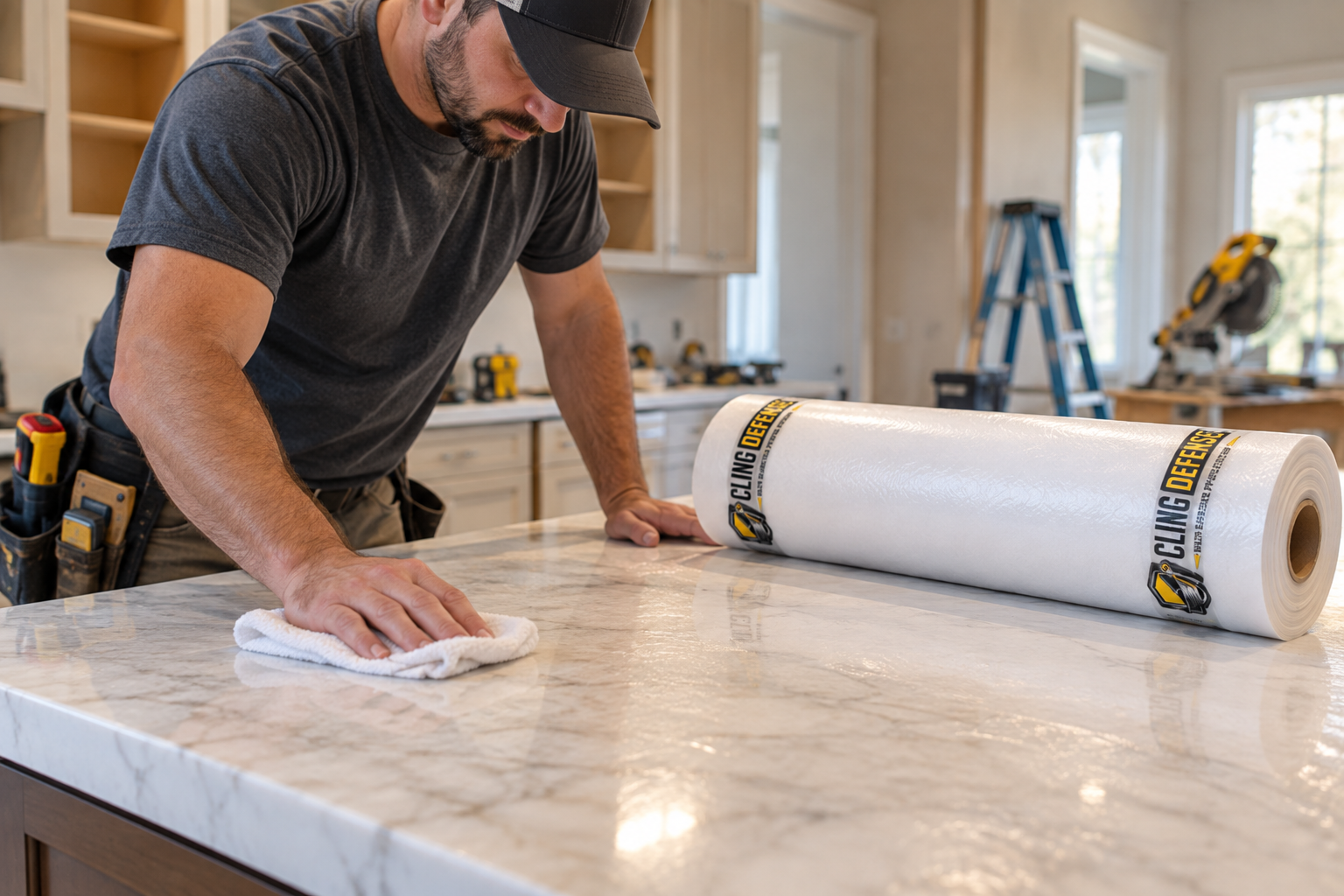
Start With a Clean, Dry Surface
A roll of gray protective film partially unrolled on a concrete floor, showing textured surface and adhesive backing, with a pair of work gloves and a utility knife nearby. Sunlight casts soft shadows, highlighting the film’s thickness and rough job-site surroundings.
Surface preparation is one of the most important steps in temporary countertop protection.
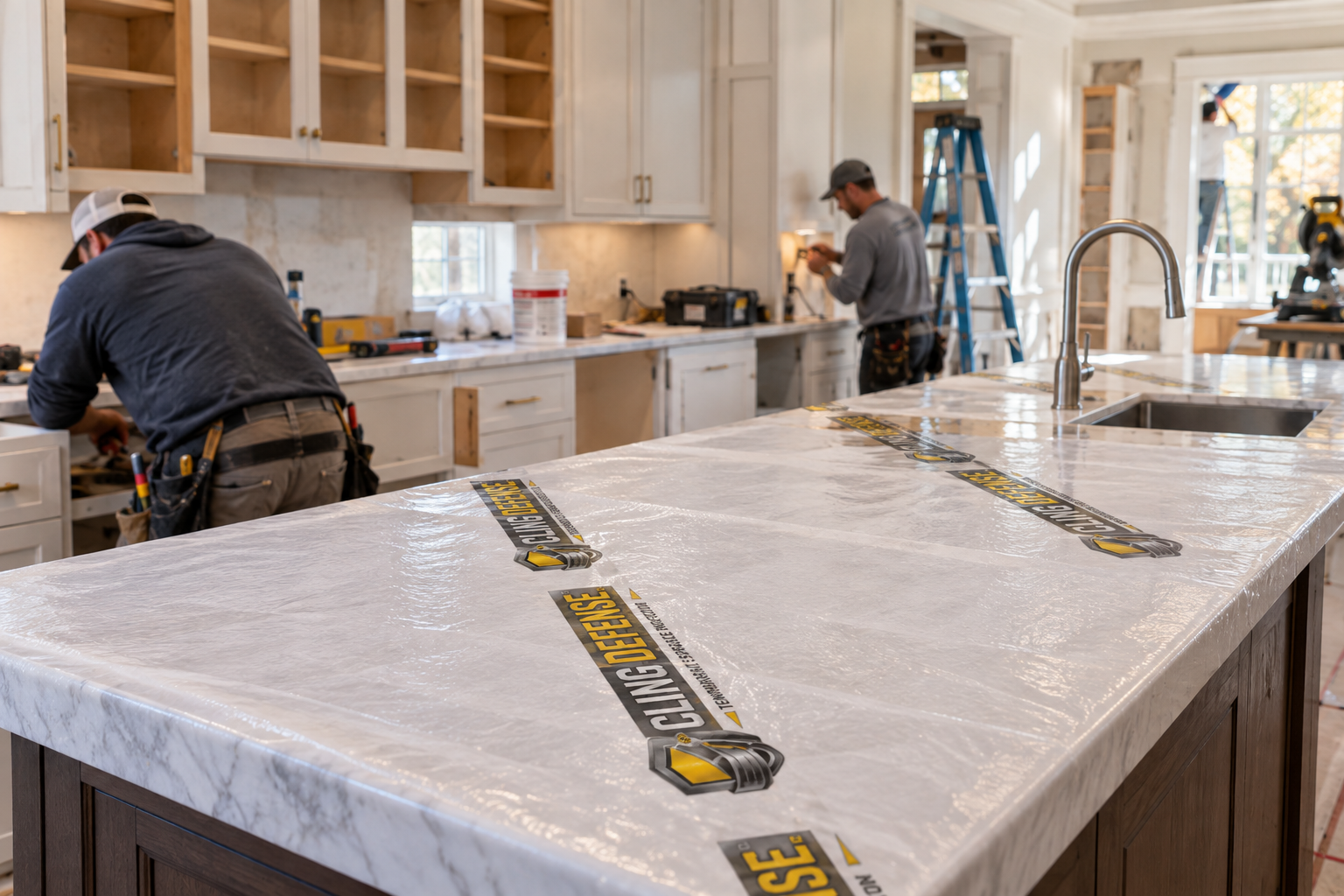
Before installing Cling Defense, inspect the countertop and confirm that it is suitable for covering. The surface should be clean, dry, and free of loose dust and debris.
Cling Defense relies on its cling properties to make contact with the surface without separate tape. Dust, dirt, and construction debris can interfere with that contact and reduce effectiveness. Those contaminants can also collect on the cling side of the material, potentially reducing its ability to cling effectively if you try to reuse it later.
The current Product Specs & Care guidance recommends:
Applying Cling Defense to clean, dry surfaces
Removing loose dust and debris before installation
Avoiding excessively dirty or contaminated surfaces
Confirming that the surface is suitable for protection
Considering a test in a small, inconspicuous area before larger applications
Following the care requirements of the underlying finished surface
If the countertop has recently been finished, coated, or treated, do not immediately cover it simply because the construction schedule is moving forward. Confirm that the surface is fully cured and suitable for covering before applying temporary protection.
When there is uncertainty about a specific surface or finish, contact Cling Defense before application.
Cut Protection to Fit
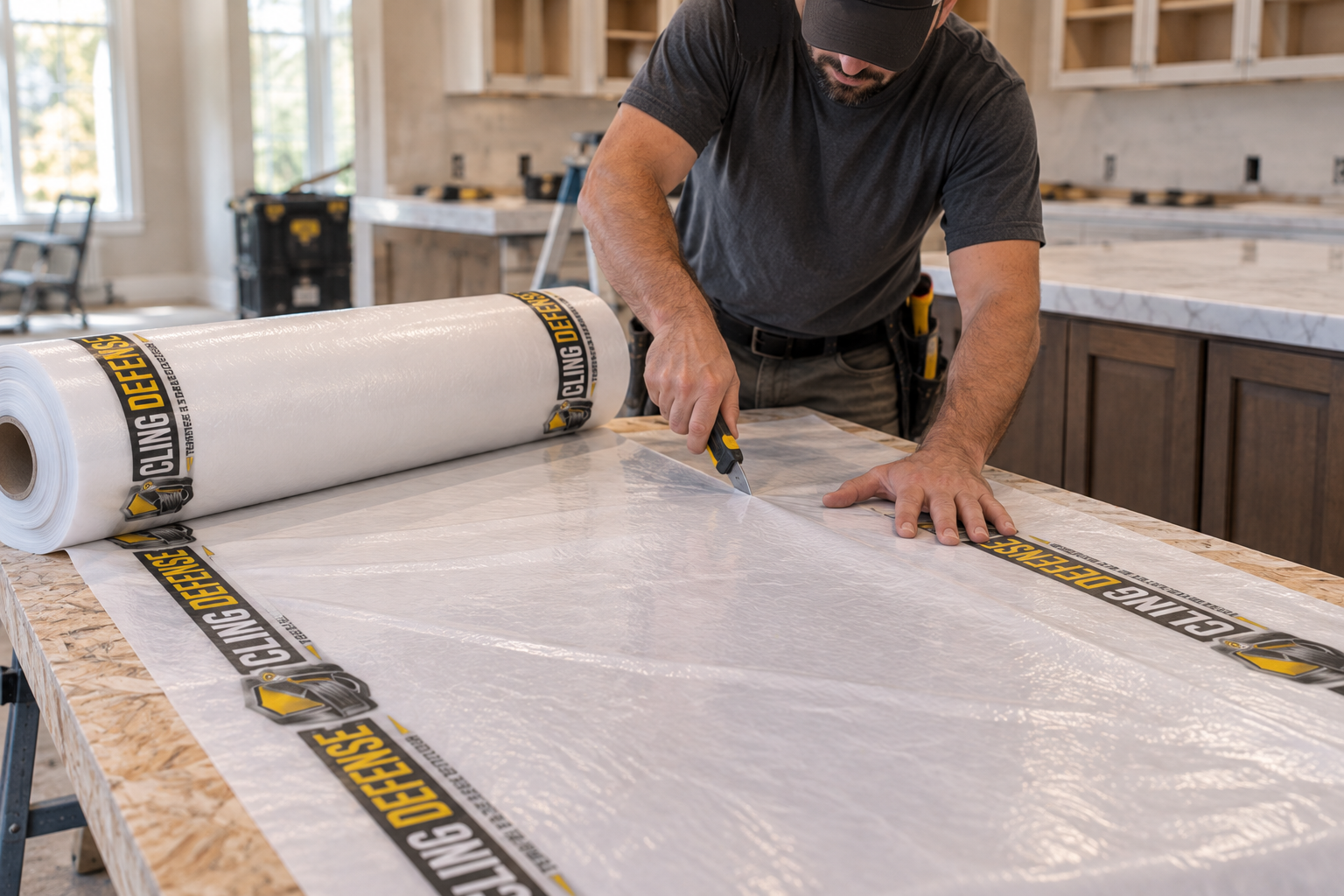
Contractor cutting temporary countertop protection away from the finished surface.
Once the countertop is prepared, roll out enough Cling Defense to cover the area that needs temporary protection.
Then cut the material to the appropriate size.
Always perform cutting away from the protected countertop.
This is a simple but important jobsite practice. Using a utility knife or other cutting tool directly against the finished surface introduces an unnecessary risk to the exact surface you are trying to protect.
Instead, determine the dimensions needed, move the material to a safe cutting location, cut it to fit, and then position it over the countertop.
This approach is particularly useful around countertop layouts where the protection may need to be sized for different sections.
The objective is not simply to put material over the countertop. It is to create deliberate, appropriately sized coverage while avoiding unnecessary contact between cutting tools and the finished surface.
Smooth the Material Into Place
After positioning the material, smooth or pat Cling Defense into contact with the countertop using hand pressure.
This step helps establish contact between the cling side and the clean finished surface.
Pay attention to the material as you work rather than assuming that rolling it across the countertop automatically completes the installation. Check the coverage and make sure the areas requiring protection are properly covered.
From there, the material serves as temporary remodeling surface protection while work continues around the countertop.
Contractors should still maintain good jobsite practices after the protection is installed. Temporary protection does not turn a finished countertop into a designated workbench, nor does it guarantee protection against every form of damage.
Think of the covering as one part of a broader jobsite protection strategy.
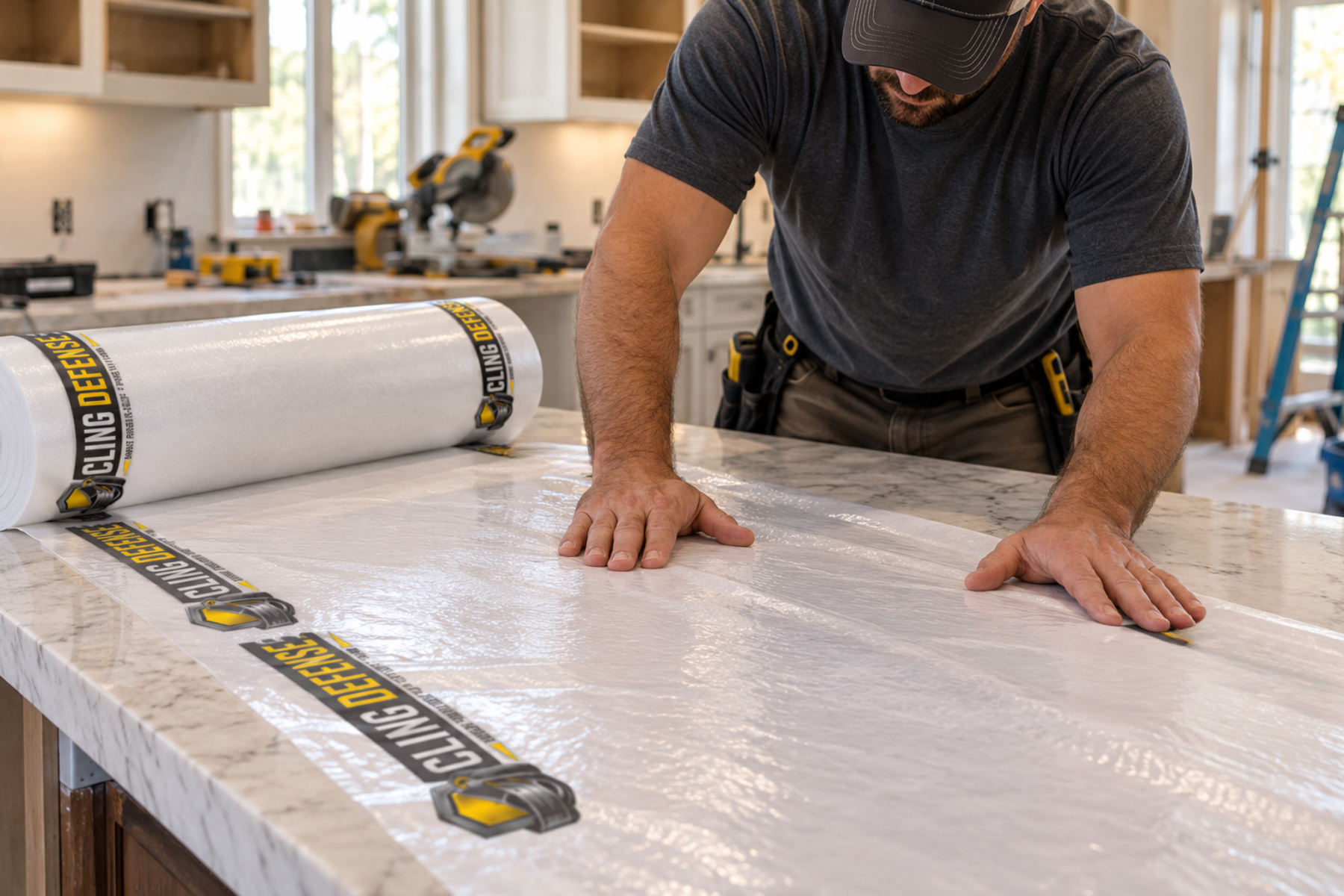
Contractor smoothing self-adhesive countertop protection into place without separate tape.
Why No-Tape Protection Can Simplify Countertop Coverage
Countertops can create a different protection challenge than an open floor.
A contractor may need to cover multiple sections of countertop while other trades continue working throughout the room. If the protection system requires separate tape to secure every piece, installation involves both the protective material and the additional securing step.
Cling Defense is self-adhesive, so no separate tape is required.
The material relies on its cling properties to make contact with suitable finished surfaces. For contractors, that can simplify the basic process: prepare the surface, roll out the material, cut it to fit away from the countertop, and smooth or pat it into place.
This is also why surface preparation matters so much.
A no-tape system still depends on proper contact. If construction dust, loose debris, or dirt is trapped between the countertop and the cling side, performance may be reduced.
No separate tape also means contractors can use the same general surface-protection approach across multiple suitable finished surfaces on a project rather than thinking only about the floor.
In a kitchen renovation, for example, that may include finished countertops and cabinets. Elsewhere on the project, Cling Defense may be used on other suitable surfaces identified by the manufacturer, including stairs, glass, doors, finished walls, and millwork.
Can Countertop Protection Be Removed and Reused?
Cling Defense is reusable when conditions allow.
That distinction matters.
Reuse should never be interpreted as unlimited reuse or as a guarantee that every piece removed from a jobsite can immediately be installed somewhere else.
The condition of the surface and the protection material both matter.
When Cling Defense is installed on a clean countertop, the cling side has a better opportunity to remain clean enough for potential reuse. After the work in that area is complete, the material can often be carefully removed, repositioned, and used again when conditions allow.
If the countertop was dusty or debris was allowed underneath the protection, particles can collect on the cling side. Heavy dirt, dust, and repeated use can gradually reduce cling performance.
Before repositioning a removed piece, inspect it.
If the cling side remains clean enough and the material is still appropriate for the next application, it may be suitable for reuse. If it has collected substantial dirt or debris, do not assume it will perform the same way it did during the original installation.
For planning larger projects, each 300 sq. ft. roll of Cling Defense measures 3 ft × 100 ft and can be cut and applied where temporary protection is needed.
The ability to remove, reposition, and use the material again when conditions allow can be useful when project phases or work areas change, but the decision should always be based on the actual condition of the material.
How Long Should Temporary Countertop Protection Stay in Place?
Cling Defense is intended to be temporary surface protection.
For shorter-duration projects, such as approximately one to two weeks, Cling Defense should remove cleanly under normal conditions.
That does not mean the material should be installed and forgotten for the entire duration of a long construction project.
When temporary protection remains applied for extended periods, such as several months, residue may become more likely depending on the surface, environment, and length of application.
For longer remodeling or construction projects, periodically check both the protected countertop and the condition of the material.
This is especially important because jobsite conditions can change over time. Dust levels, ongoing trade work, environmental conditions, and the duration of installation can all affect how temporary protection performs.
The proper application guidelines provide current recommendations for surface preparation, reusability, temporary use, removal, and care.
The practical takeaway for contractors is straightforward: temporary countertop protection should be actively managed as part of the project, not treated as an indefinite covering.
If the project schedule extends well beyond the initial installation period, check the material and the underlying surface periodically rather than waiting until final cleanup.
Removing Protection and Handling Potential Residue
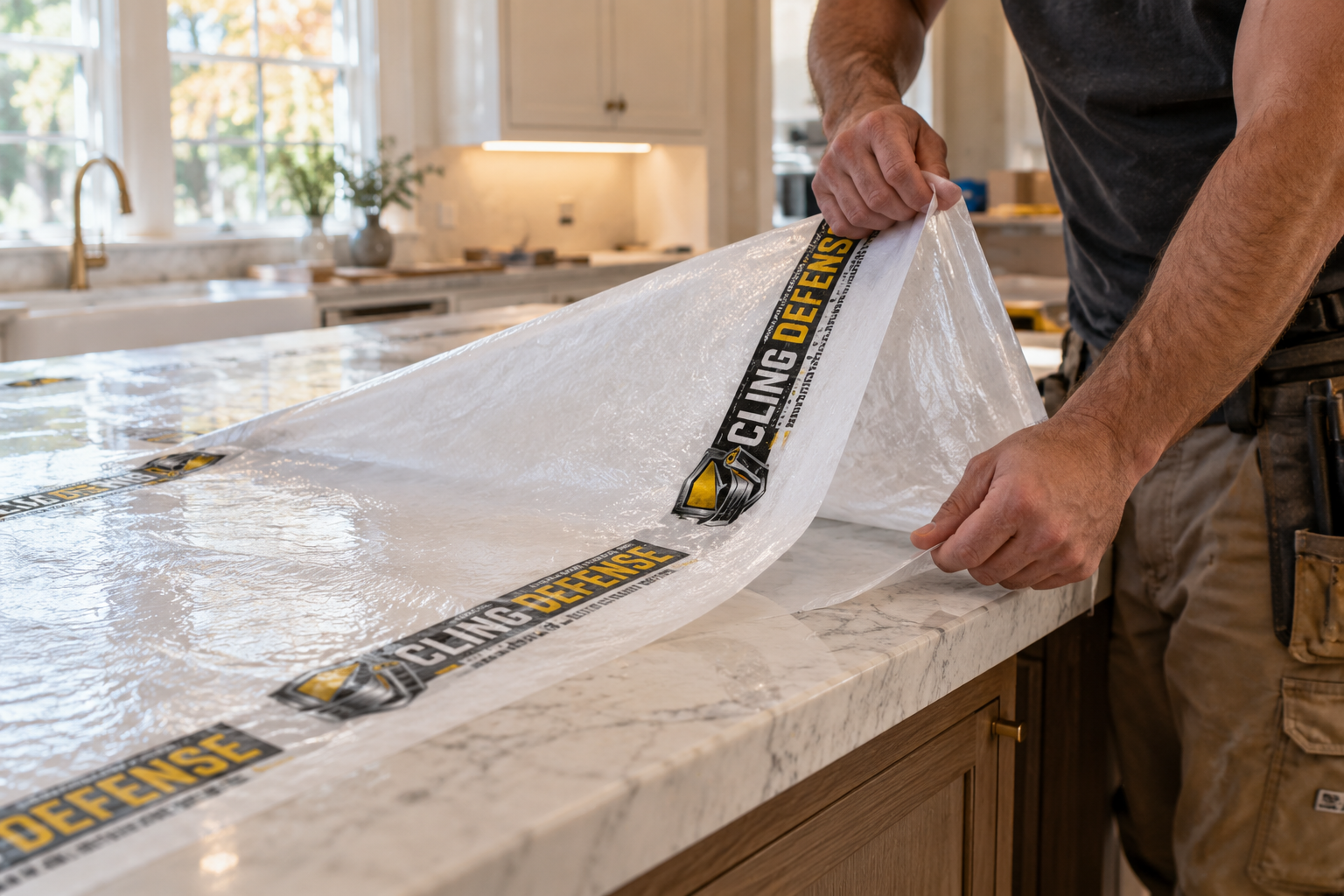
Contractor carefully removing temporary protection from a finished countertop.
Removal deserves the same attention as installation.
When the countertop no longer needs protection, carefully peel Cling Defense away from the finished surface.
Avoid rushing the process. Once removed, inspect both the countertop and the cling side of the protection.
If the material remains clean enough and jobsite conditions allow, it can potentially be repositioned or saved for reuse.
For shorter-duration projects of approximately one to two weeks, Cling Defense should remove cleanly under normal conditions. However, residue-free removal should not be treated as a guarantee.
When Cling Defense remains installed for extended periods, such as several months, residue may become more likely depending on the surface, environment, and duration.
If residue is present, keep the cleaning process simple.
Current Cling Defense guidance recommends hot water + Dawn® dish soap.
Gently clean the affected area using hot water and Dawn® dish soap until the remaining residue is removed, while always following the care requirements of the underlying finished surface.
Do not use solvents, aggressive chemicals, or specialty cleaning products.
Using harsher products in an attempt to speed up residue removal may introduce unnecessary risk to the finished countertop. The cleaning requirements of the underlying surface should always take priority.
Ultimately, effective countertop protection during construction depends on more than placing a covering over the finished surface.
Start by confirming that the countertop is suitable for protection. Make sure it is fully cured when newly finished, coated, or treated. Clean and dry the surface. Remove loose dust and debris. Cut the protection away from the countertop. Smooth it into contact. Monitor it during longer projects. Then remove it carefully when protection is no longer needed.
That process helps contractors protect finished work while painters, electricians, cabinet installers, and other trades continue moving the project toward completion.
Protect countertops and other finished surfaces with a 300 sq. ft. roll of Cling Defense. Contact the team for ordering information - 603-331-4413 or info@clingdefense.com